The Bread of Life
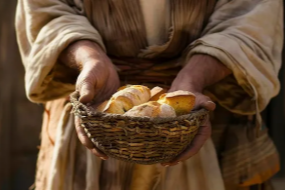
Vignette One
I am the bread of life. He who comes to Me shall never hunger, and he who believes in Me shall never thirst.”
The Scene
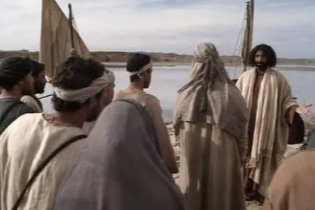
It is nearly Passover, a time of pilgrimage, when the people of Upper Galilee prepare for the four-day journey to Jerusalem to celebrate the feast and bring their sacrifices to the temple. We open on a beach on the far side of the Sea of Galilee. One of the apostles' boats waits on the shore for the Master’s return home, while a small crowd has spent the morning listening to his teachings. As several more boats drew up to the shore, those who had searched for Him in every place imaginable disembarked, relieved at last to have found Him. But an argument quickly arises regarding what they had witnessed the day before – when five thousand were fed with a boy’s lunch! They had interpreted it as a sign and tried to make Jesus their king. But maybe they misunderstood …
The narrative shifts scenes midway through as the same conversation begun on the beach reoccurs in Capernaum’s synagogue. In this formal setting, Jesus’s response on the beach with those who argued with Him becomes the central theme of His Sabbath message. But the mysteries behind His symbolic language go deeper and, in the end, stir up an even stronger reaction of anger and rejection.
The Backstory
Earlier (Signposts to Eternity, chapter 4), a signpost between Capernaum and Bethsaida directed us away from the shore of Galilee to a remote meadow. From this quiet landing on the northern shore, where the apostles’ boat was secured, we hiked uphill to join Jesus and His apostles in a secluded resting place high above the lake (re-read John 6:1-21). With panoramic views of the towns along its coastline, they relaxed contentedly in the grass after long days of ministry and recovering after hearing the troubling news of John the Baptist’s death.
Jesus had sent the twelve apostles, two by two, on a mission trip, and now their return brought renewed anticipation that Jesus would again direct his attention to the region. Their leisure did not last long, for a crowd of thousands tracked their retreat and gathered around them. Instead of ministering to the apostles’ fatigued bodies and grieving hearts, Jesus spent the day teaching and ministering to the needs of the crowd.
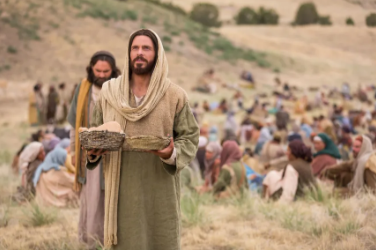
Late in the afternoon, the apostles came to Jesus and asked Him to send the crowds away. They claimed it was to buy food, though it was probably their own hunger driving them. To their surprise, Jesus replied, “You give them something to eat.”
And though His response puzzled them, you’ll come to understand how foretelling that simple statement was in the scenes that followed. After some embarrassment on their part,Jesus was given five loaves and two fish, and the apostles instructed the people to sit in groups. Then Jesus gave thanks in prayer, broke the bread and fish, and distributed the food to His apostles, who then brought it to the groups of people.
When the people realized that Jesus had miraculously fed them, they interpreted the sign to mean that Jesus was the prophet Moses had promised, ‘who would be like him’, for, like Moses, He had fed them and taught them. What need had they to make the journey for Passover when the long-awaited Messiah had shown Himself to Israel – not in Jerusalem, but in Galilee? They tried to make Him their king, but Jesus disappointed the multitude, leaving them behind, and went higher up the hillside to pray.
Now Mark’s gospel mentions an interesting interlude in the story, revealing how the apostles misunderstood what transpired. (read Mark 6:30-44) When they saw Jesus walking to them on the water, they were terrified, thinking He was a ghost. But Jesus spoke to them at once: “Don’t be afraid, take courage! I am here!” Then he climbed into the boat, and the wind stopped. They were totally amazed, for they still didn’t understand the significance of the miracle of the loaves. When they should have gained confidence in Jesus ability to overcome in every circumstance, their hearts were too hard to take it in.
It was early the next day when crowds began searching for Jesus again. They knew the apostles had departed by boat, leaving Him behind, so they searched the hillside and scoured Capernaum, without finding Him. When they left Capernaum and were joined by boats from Tiberias, they crossed to the other side of the lake and found Him near Gennesaret healing the sick and teaching. Having searched so far and wide, they asked, “Teacher, when did You come here?” for their intentions had not changed. (read Matthew 14:34-36; and John 6:22 – 59)
The Drama
Jesus knew how relentlessly they had searched for Him, but He also knew the duplicity of their hearts. He confronted them, saying, “I tell you the truth, you want to be with me because I fed you, not because you understood the miraculous signs. But don’t be so concerned about perishable things like food. Spend your energy seeking the eternal life that the Son can give you. For God, the Father has given me the seal of His approval.”
According to the rabbi’s, the ‘seal of God’ was ‘the truth’. So, to His listeners, His words conveyed that, for ‘real bread’, they must come to Him because God had impressed upon Him His own seal of truth.
Yet, if He would not be their king, then could He be their Messiah? All that the first deliverer, Moses, had done, wouldn’t the second, the Messiah, also do? They could not disbelieve, and yet they could not believe. So, they sought ‘a sign’ to guide them and an explanation to give them an understanding. They said to Him, “What sign will You perform then, that we may see it and believe You? What work will You do? Our fathers ate the manna in the desert; as it is written, ‘He gave them bread from heaven to eat.’” Again, their words and their actions showed that, though they had seen miracles, they did not see ‘the sign’. Remaining cemented in their rigid traditionalism and carnal expectations about the Messiah, they could not discern a higher spiritual meaning in what they saw. Their eyes were in their stomachs, not on the Father in heaven, whose Kingdom had come to them.
Then Jesus explained it to them plainly, “Most assuredly, I say to you, Moses did not give you the bread from heaven, but My Father gives you the true bread from heaven. For the bread of God is He who comes down from heaven and gives life to the world.” It’s no surprise that the people standing by replied, “Lord, give us this bread always.” And the same would have held true in Capernaum’s synagogue the next Sabbath had the lesson ended there. But in that formal setting, where the Law and the Prophets were set forth before the people each week, Jesus expounded further, saying, “I have come down from heaven, not to do My own will, but the will of Him who sent Me. This is the will of the Father who sent Me, that of all He has given Me I should lose nothing, but should raise it up at the last day”.
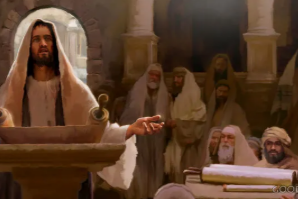
The controversy was set ablaze! How could any man make such claims as having come from heaven, with God as his father?
Excusing the very truth that stood before them, they complained that, knowing His parentage and earlier history, they could not alter their Messianic expectations or their allegiance to their traditions. When Jesus added, “I am the living bread which came down from heaven. If anyone eats of this bread, he will live forever; and the bread that I shall give is My flesh, which I shall give for the life of the world,” the murmuring erupted into quarreling as each man turned to his neighbor in disbelief, grumbling, “How can this Man give us His flesh to eat?” Yet Jesus doubled down on His claims, promising, “Whoever eats My flesh and drinks My blood has eternal life, and I will raise him up at the last day. For My flesh is food indeed, and My blood is drink indeed. He who eats My flesh and drinks My blood abides in Me, and I in him. As the living Father sent Me, and I live because of the Father, so he who feeds on Me will live because of Me.”
The Message
Jesus had told them, “I am the bread of life. He who comes to Me shall never hunger, and he who believes in Me shall never thirst.” And in so saying, Jesus gave this guarantee, “Everyone that the Father gives Me will come to Me, and the one who comes to Me I will by no means cast out.” But this fellowship was to be secured in ways beyond natural interpretation; they consisted only in abiding in Him, and He in them, an inner communion with Him that shared His condition and views – a totally different Messiah and Messianic Kingdom from what they had conceived.
Jesus declared, “As the living Father sent Me, and I live because of the Father, so he who feeds on Me will live because of Me. This is the bread which came down from heaven—not as your fathers ate the manna, and are dead. He who eats this bread will live forever.” There is nothing and nowhere else one may find the words of eternal life; Jesus is the Holy One and the truth of God expressed.
Do you recall what Jesus said to the apostles when He was about to feed the five thousand miraculously? Jesus told them, “You give them something to eat.” Then Jesus gave thanks in prayer, broke the bread and fish, and distributed the food to His apostles, who then brought it to the groups of people.

In the very same way today, Jesus abides in His believers; and receiving the bread of life from the Master's words, they distribute it to the hungry multitude all around them.
The Conclusion
We can assume that those who murmured and complained did not receive His message. Yet, it is truly unfortunate that we read that, “many of His disciples, when they heard this, said, ‘This is a hard saying; who can understand it?’” To them He responded, “It is the Spirit who gives life; the flesh profits nothing. The words that I speak to you are spirit, and they are life.” Jesus asked the apostles if His message had also driven them away, yet Peter replied, “Lord, to whom shall we go? You have the words of eternal life.” And this is the message – that as bread is nourishment to the body, the words of Jesus are life to the spirit. We must feed on His words daily, as living bread, and receive His promise of eternal life. Not a life to be lived in eternity, but rather, the life of eternity living within us.