The Door of the Sheep

Vignette Three
…the sheep hear his voice; and he calls his own sheep by name and leads them out. And when he brings out his own sheep, he goes before them; and the sheep follow him, for they know his voice. (John 10:3-4)
The Scene
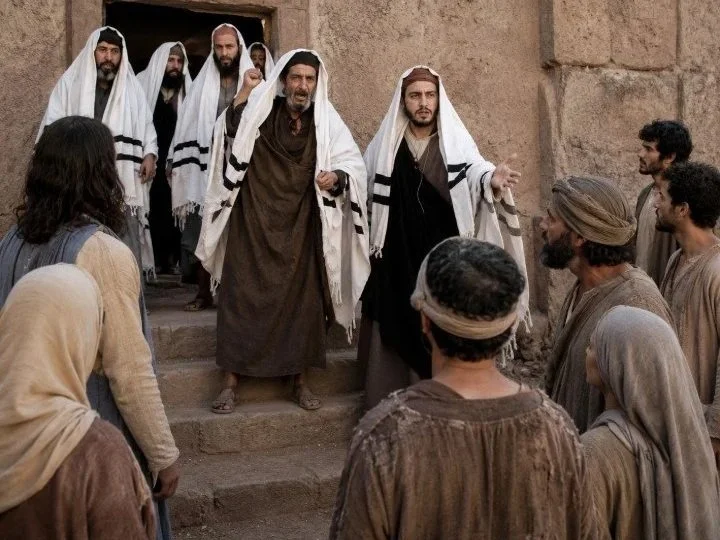
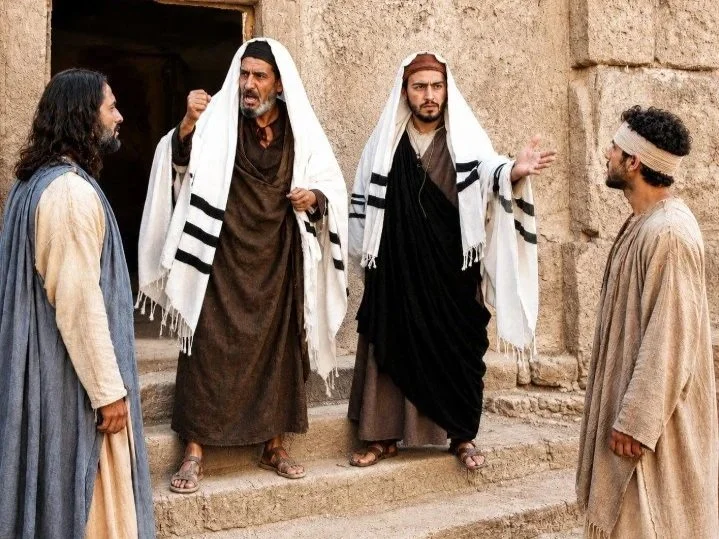
Even the poorest sections of Jerusalem had a synagogue as the center of their community. Rabbinic sources claim there to have been nearly four hundred synagogues in Jerusalem in the mid-first century; though modern skeptics somehow deduce the tally to be greatly exaggerated. Nevertheless, the synagogue was where the Scriptures were read daily and where religious leaders taught the people what the Law of Moses expected of them. Within our view we see narrow streets lined with small houses baked grayish tan in the Middle Eastern sun, opening onto a cobblestone area in front of a plain, square building. Standing outside, a bedraggled middle-aged man stands with his parents as Jesus approaches with His disciples. As Jesus starts to speak with the man, their conversation attracts the attention of several astutely dressed men exiting the synagogue. Provoked by Jesus presence, these scholars of the Law gather around to question Jesus about His authority.
As we begin chapter 10, the apostle John is in the middle of a discourse, written to encapsulate what he witnessed. At times, what we have printed as a chapter break is really one scene running into another without any stage direction.
An argument in the Temple in chapter 9 fades while another argument emerges in chapter 10 at a dusty square outside of a rustic synagogue across town. The central argument being discussed in both places becomes the bridge that gives continuity to the changing scenery.
The Backstory
To rightly understand what’s happening, you need to go back to the end of chapter 8. Frequent altercations between Jesus and the religious leaders occurred in the Temple in Jerusalem. These men considered themselves to be the bona fide teachers of Israel. So, when Jesus taught the people, “If ye continue in my word, then are ye my disciples indeed; and ye shall know the truth, and the truth shall make you free,”(John 8:31-32) they rejected His promise saying they were already the free children of Abraham. The confidence they placed in their learning and heritage kept them blind to their own errors and faulty teaching. The arguments became so heated that “They took up stones to cast at him.”(John 8:59)
When Jesus and the disciples were leaving the Temple they passed a blind man. Although the disciples embraced Jesus's teachings, much of what they’d learned from the religious leaders needed to be unlearned. With all the questions about keeping the Law, the disciples were perplexed about the guilt of sin.
So, they asked, “Rabbi, why was this man born blind? Was it because of his own sins or his parents’ sins?” But Jesus came to show us heaven’s perspective. He had a very different way of looking at the situation, so he answered, “It was not because of his sins or his parents’ sins. This happened so the power of God could be seen in him.” (John 9:3-5) [Note: this is where Jesus proclaims Himself to be the Light of the World … which we discussed in the previous Vignette.]

Having placed some mud on the man’s eyes, Jesus sent him to Pool of Siloam to wash, then continued the day’s activities with His disciples. Meanwhile, the blind man did as Jesus told him. He went to Siloam and washed and he received his sight. The man’s transformation was so astonishing that his neighbors had difficulty believing he was the same man.
Yet, to the teachers of the Law, the act of healing and the way it was performed were controversial, for this all took place on a Sabbath day when labor is strictly prohibited! So, the following day, the blind man was brought to the synagogue; to seek the judgment of the Pharisees and teachers of the Law on the matter. “Some of the Pharisees said, ‘This man Jesus is not from God, for he is working on the Sabbath.’ Others said, ‘But how could an ordinary sinner do such miraculous signs?’ So, there was a deep division of opinion among them.” (John 9:16) It was the blind man who stated the obvious, saying, “I don’t know whether he is a sinner, but I know this: I was blind, and now I can see!”(John 9:25)
The Drama
The tension is building! First, the man who had been blind and his parents were threatened with excommunication for their testimony about Jesus. And, while the religious leaders threatened to arrest Jesus, the people were believing in Jesus in increasing numbers. “After all,” they said, “would you expect the Messiah to do more miraculous signs than this man has done?” (John 7:31) It particularly angered the scholarly Pharisees when the ‘ignorant’ people were confessing, “Surely this man is the Prophet we’ve been expecting,” and, “He is the Messiah.” (John 7:40)
Assuming their position as teacher and judge, the leaders would stop at nothing to silence such unauthorized assertions. Don’t miss how furiously they pressured the man to disavow his miraculous cure! Their rage and animosity sprang from resentment as Jesus’ actions exposed the error behind their claims to authority. As a result, the man was able to turn what was obvious into an indictment against his accusers. “Why, this is a marvelous thing, that you do not know where He is from; yet He has opened my eyes! Now we know that God does not hear sinners; but if anyone is a worshiper of God and does His will, He hears him. Since the world began it has been unheard of that anyone opened the eyes of one who was born blind. If this Man were not from God, He could do nothing.” (John 9:31-33)
The man with an experience always wins in an argument with someone who only has doctrine. The message was clear to the disciples, for the power of God was seen in the man. But those in authority remained blind to the lesson.
But Jesus is about to challenge the very understanding they held so highly, exposing how far their doctrine had strayed, and how blind they had become to the truth. “For judgment I have come into this world, that those who do not see may see, and that those who see may be made blind.” The Pharisees recoiled at His words, demanding, “Are we blind then?” And Jesus answered, “If you were blind, you would not be guilty; but now you say, ‘We see.’ Therefore, your guilt remains.” (John 9:39-41)
The Message
The religious leaders and teachers of the Law needed a visual that would explain their true standing and what they were really doing. Heaven viewed the people under their care far more important than their leadership position. So, Jesus began by using a common agricultural illustration. A sheepfold is an enclosure, sometimes made with stones, sometimes with heavy, twisting branches; but always with an entryway through which the sheep enter for their safety. It may have a gate to keep the sheep in, but a porter, or under-shepherd guards the opening through the night to keep mischief out! The illustration was familiar to the Pharisees, not because they were standing by a sheepfold or that they herded literal sheep, but because the figure was often used in scripture for God’s leaders, and they themselves bolstered their authority by assuming the title, ‘shepherds of God’s people.’
Jesus used the allegory to address the manner in which they came to have authority over the people. “Most assuredly, I say to you, he who does not enter the sheepfold by the door, but climbs up some other way, the same is a thief and a robber,” (John 10:1) In God’s assessment, these self-appointed teachers had claimed their authority by theft. In contrast, Jesus says, “He who enters by the door is the shepherd of the sheep.” In this He indicates that God had appointed Him as the true shepherd of His people. The under-shepherd that guards the door to the sheepfold only opens to the true shepherd when he comes to lead the sheep out to pasture.

“He calls his own sheep by name and leads them out. And when he brings out his own sheep, he goes before them; and the sheep follow him, for they know his voice. Yet they will by no means follow a stranger, but will flee from him, for they do not know the voice of strangers.” (John 10:3-5)
The religious leaders, who gave the appearance of caring for the sheep, were angered by the multitudes who had rejected their authority and clung to Jesus’ teachings. Their narcissistic responses proved they were thieves and not true shepherds. All they had were witty illustrations to imply their authority; they could not understand what Jesus was saying to them.
To put it more plainly, Jesus explained his own position with two familiar statements; and here we have the ‘I am’ statements for this vignette:

“I am the door. If anyone enters by Me, he will be saved and will go in and out and find pasture. The thief does not come except to steal, and to kill, and to destroy. I have come that they may have life, and that they may have it more abundantly. (John 10:9-10)
“I am the good shepherd. The good shepherd gives His life for the sheep. But a hireling, he who is not the shepherd, one who does not own the sheep, sees the wolf coming and leaves the sheep and flees; and the wolf catches the sheep and scatters them. The hireling flees because he is a hireling and does not care about the sheep.” (John 10:11-13)
Understanding the context and setting for these declarations helps us grasp their application and importance; following vain instructions and self-serving agendas is thievery by the false authorities and abusive to the sheep.
The Review
So many voices are speaking today; voices that desire to enlist and secure your loyalty. How do we know who we should follow? In these two declarations Jesus describes who He really is and His care and concern for YOU! They also explain the place the ‘Media Prophets’ and ‘Social Influencers’ should have in our lives. First, let’s clearly understand that in this context we are all sheep, and that God is the true owner of the sheep. The entrance God has provided into the sheepfold is His unconditional love, His pardoning grace, and His saving mercy. The same indictments Jesus spoke against the religious leaders stand true today. Access to the sheep does not come by conditional acceptance, unforgiving condemnation, and bigoted rejection. Leaders of this type cloak their intentions with attractive presentation and persuasive words, but like a thief, they only come to steal, kill, and destroy!
Nearly six centuries before Jesus’ time, the prophet Ezekiel warned the religious leaders of Israel. He declared that the Sovereign Lord was dissatisfied with the shepherds of His people. He rejected them and promised them many sorrows. But also promised, “I will be like a shepherd looking for his scattered flock. I will find my sheep and rescue them from all the places where they were scattered on that dark and cloudy day.” (Ezekiel 34:12)

And yet, two millennia later, should you be so independent that you say you don’t listen to anyone but yourself, Isaiah’s words would reprove and show that you still need to hear and follow God’s promised shepherd. “All of us, like sheep, have strayed away. We have left God’s paths to follow our own. Yet the Lord laid on him the sins of us all.” (Isaiah 53:6)
As sheep, we will all receive care and direction from someone. Why not tune your ears to the voice of the only One who truly cares for you. He feeds His flock with love, grace, and forgiveness. He is life and gives eternal life.
“The sheep hear his voice; and he calls his own sheep by name and leads them out. And when he brings out his own sheep, he goes before them; and the sheep follow him, for they know his voice.”